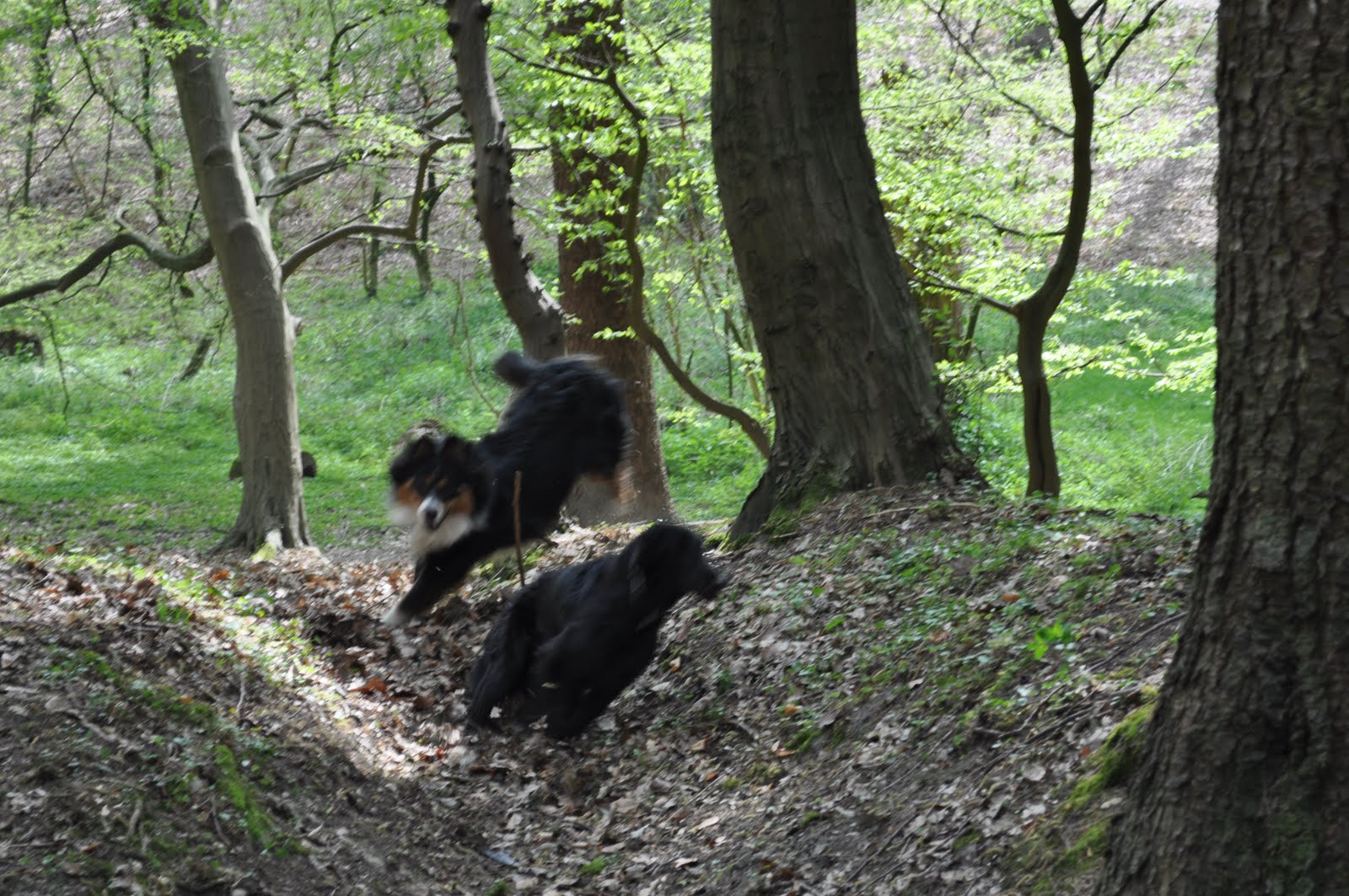
Today when I took Ozzy out for a walk in a wooded park, we came across a Malinois. He was off the lead and went for Ozzy. He tackled Ozzy into a submissive position and started biting him in the neck whilst growling furiously. Quite impressive. I remain calm in situations like these and walk on and call Ozzy to me. This usually diffuses the confrontation. Not this time. I managed to call Ozzy to me without showing any distress but by asserting control. The owner started sreaming at his dog and said "you'll get it in the neck, mate". This is exactly what happened. The poor dog was wearing an electric shock collar and his owner was so angry, he pushed the button for such a long time the dog started shaking and frothing at the mouth. This was obviously not enough for him. He took the lead and started beating his dog with the end with the buckle. The dog whelped. By this time Ozzy and I were at a safe distance. Luckily Ozzy is very sweet natured and trusts me so he was not affected by the scene. I did not think it was wise to make a comment to the man but I was upset for the poor dog and very angry with his owner. Poor Malinois, obviously in the wrong hands.
Saturday, 14 May 2011
Wednesday, 11 May 2011
The Belgian connection
A dog with titanium teeth had accompanied the US military team that killed Osama Bin Laden in Pakistan . According to the Sun, at least one of the special breed of Belgian shepherds called "Malinois" backed the Navy Seals mission that killed Osama. Highly placed military sources said a dog joined the 79-strong elite team "choppered" into Abbottabad, ten days before the raid. Its surgically enhanced teeth are strong enough to pierce a bullet-proof vest, the paper said. It has emerged that dogs equipped with infrared night-sight cameras and armoured vests have been used in the past by the top-secret unit. The animals have even been provided with special gas masks earlier to ward off chemical attacks in Iraq and Afghanistan
Monday, 2 May 2011
Another playmate
Ozzy playing with Joyce, a 10 month flatcoated retriever. Proof again that Ozzy is not a dominant dog.
( Click on pictures to enlarge )
Thursday, 21 April 2011
Ozzy's playmate
I was out walking the other day in the forest and we came across Max, a standard poodle. He was with his Swedish owner. We had actually met before so it was normal the dogs immediately started playing. They are approximately the same age.
In play dogs imitate wolf behaviour. Dogs like wolves convey the rules of the pack through body language and use it to express themselves. In this last picture on the left you can see that Max is the more dominant male or the more high ranking in the pack. Ozzy adopts a totally passive and submissive position by drawing his paws into his body and by exposing his neck, chest and abdomen, the most vulnerable parts of his body. Ozzy probably comes across as an unruly and boisterous adolescent. No aggression was shown in this encounter. A bit of growling on the part of Max and a bit of whimpering on the part of Ozzy. The dogs parted amicably as did their owners.
Friday, 15 April 2011
Who's who?
![]() |
| Belem |
![]() |
| Belem |
This is Belem Lukeyon de la Baule or Belem. He is 4 years old and he belongs to my French friend, CdG, who lives in La Baule.
| Ozzy |
And this is Ozzy. 8 months and two weeks today.
Monday, 11 April 2011
First encounter
Ozzy found a new playmate in the forest yesterday. We came across Lara, a beautiful Russian Black Terrier. Quite a rare breed here in Western Europe. In fact, it was the first time I came across this breed. She was beautiful and did not mind Ozzy’s wild manners. Her owner, who was about my age, pointed out that she called her Lara after the character in Doctor Zhivago and not after Lara Croft!
During the 1930's, a military kennel named the Red Star, in Moscow, started working on a native breed that would be part of the national security force. Attempting to create the breed at that time was quite a challenge due to the slaughter of much of the purebred dog stock during the Russian Revolution, and additional depletion of pure stock during the World War and economic disasters.
Their breeding program came to life after World War II by working on selective interbreeding using giant Schnauzer, Rottweiler, Airedale and Newfoundland breeds. All in all, a total of 17 breeds were used to create the Black Russian Terrier. It was important to have a large breed, not only reliable but highly trainable in many different situations. The dog would also have to be able to endure the harsh Russian winters.
The dogs were initially used by the military police at border crossings, prisons, and military installations. In 1956 the Red Star Kennel released dogs to private breeders. The first breed standard was created by the Red Army in 1958, and was revised several times before 1981. In 1981, the Russian Ministry of Agriculture recognized the breed and it was internationally accepted by the FCI (Fédération Cynologique Internationale) in 1984.
During the 1930's, a military kennel named the Red Star, in Moscow, started working on a native breed that would be part of the national security force. Attempting to create the breed at that time was quite a challenge due to the slaughter of much of the purebred dog stock during the Russian Revolution, and additional depletion of pure stock during the World War and economic disasters.
Their breeding program came to life after World War II by working on selective interbreeding using giant Schnauzer, Rottweiler, Airedale and Newfoundland breeds. All in all, a total of 17 breeds were used to create the Black Russian Terrier. It was important to have a large breed, not only reliable but highly trainable in many different situations. The dog would also have to be able to endure the harsh Russian winters.
The dogs were initially used by the military police at border crossings, prisons, and military installations. In 1956 the Red Star Kennel released dogs to private breeders. The first breed standard was created by the Red Army in 1958, and was revised several times before 1981. In 1981, the Russian Ministry of Agriculture recognized the breed and it was internationally accepted by the FCI (Fédération Cynologique Internationale) in 1984.
Friday, 1 April 2011
Book at bedtime Part 2
In an article on training domestic dogs about feeding:
"In the old days, before war altered the lives of dog owners, feeding was a fairly simple business. Lean meat, lightly cooked, but not boiled, at the rate of half a pound for twelve pounds weight of dog, is a fair allowance, but war rations make any meat possible, except horseflesh, and so until easier times return, the best that can be done is with biscuits, fish scraps and whatever bones can be provided from household joints. A point to remember is that salt in any form should be avoided. But a fresh supply of water, supplied daily in a clean bowl, constantly refilled, is a prime necessity. Dogs are always wantig to drink, so keep the bowl in the shade.
A reminder: See that food intended for the household table is kept in the larder, or when needed for a meal is placed out of the dog's reach. And if the dog should somehow find and make away with food intended for the table, do not be angry with him. It will have been your fault."
Remember this was written at the end of the 1940s.
"In the old days, before war altered the lives of dog owners, feeding was a fairly simple business. Lean meat, lightly cooked, but not boiled, at the rate of half a pound for twelve pounds weight of dog, is a fair allowance, but war rations make any meat possible, except horseflesh, and so until easier times return, the best that can be done is with biscuits, fish scraps and whatever bones can be provided from household joints. A point to remember is that salt in any form should be avoided. But a fresh supply of water, supplied daily in a clean bowl, constantly refilled, is a prime necessity. Dogs are always wantig to drink, so keep the bowl in the shade.
A reminder: See that food intended for the household table is kept in the larder, or when needed for a meal is placed out of the dog's reach. And if the dog should somehow find and make away with food intended for the table, do not be angry with him. It will have been your fault."
Remember this was written at the end of the 1940s.
Subscribe to:
Posts (Atom)